Bonds

Bonds are a type of debt instrument. It is a method through which governments or companies raise funds. Institutions issue bonds and promise to pay regular interest payments to the investor. The main difference is that a bond is highly tradeable. Bonds also have credit ratings.
How do bonds/t-bills generate income?

Interest Payments

Coupon Payments

Bonds generate income through periodic interest payments, called coupons, which are based on the bond's face value and fixed at the time of issuance.

Zero Coupon Bonds

Buying at a discount

Sold at a discount and generate income when they mature by paying the full face value. Various bond types may offer income through different mechanisms and features, such as callable or puttable options, affecting how income is generated.

Capital Gains

Increase value over time

Bonds can also provide income through potential capital gains, where the bond's market price may rise if interest rates decrease, allowing for profit upon sale. However, capital gains are subject to market conditions and not guaranteed.

Types of Debt Securities

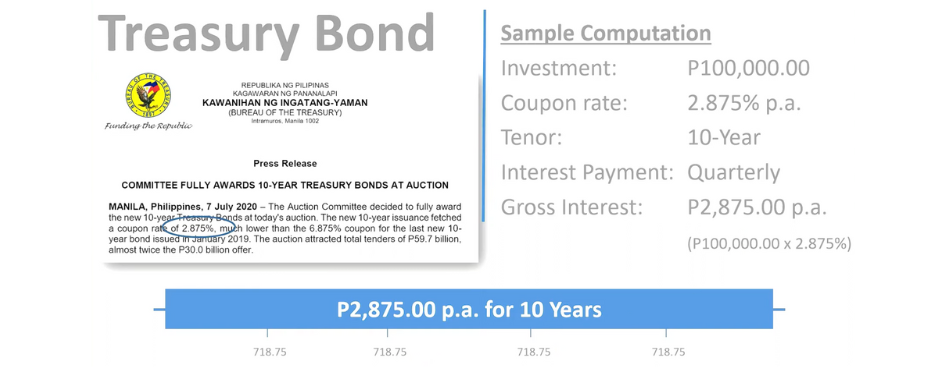
Treasury Bonds

aaaequities

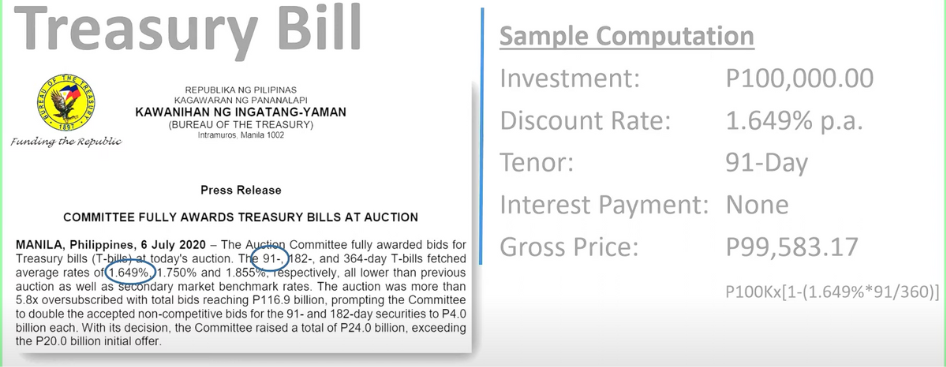
Treasury Bills

colfinancial

Corporate Bonds

interactive brokers

Long-term debt securities issued by the government. Pay periodic interest to investors at a fixed rate, and repaid upon maturity

Short-term debt instruments issued by the government to raise funds. Investors purchase T-Bills at a discount to their face value and receive the full face value when the T-Bill matures.

Investment gains can help you hedge your assets against inflation

How to compute gains for Treasury Bills


How to compute gains for Treasury Bonds


Comparison of T-Bills, T-Bonds, Corporate Bonds

Aspect Treasury Bills Treasury Bonds Corporate Bonds
Issuer Government Government Corporations
Maturity Short-term (Usually up to 1 year) Long-term (typically 20 to 30 years) Varies (typically 1 to 30 years)
Interest/Coupon No fixed interest, sold at a discount Fixed interest payments (coupons) Fixed or variable interest payments (coupons)
Risk Very low-risk (government backed) Very low-risk (government backed) Varies based on the company's creditworthiness
Market Active Secondary Market Active Secondary Market Active Secondary Market
Liquidity High High Moderate to High